RV Gear ›
9 Best RV Water Heaters Reviewed in 2026 – Buying Guide
by Jake Mercer
Tankless systems eliminate the recovery wait entirely by heating water on demand as it flows through the heat exchanger, but they introduce their own requirements: consistent propane pressure, adequate 12V power for the control electronics, and a minimum trigger flow rate to activate ignition. The best modern units reviewed here — including the FOGATTI InstaShower Ultra and Suburban ST-60 — have addressed the most common pain points with microprocessor control and low-flow ignition technology, bringing the tankless experience closer to residential quality than anything available in the RV category five years ago.
BTU Output and Flow Rate: Understanding What the Numbers Mean
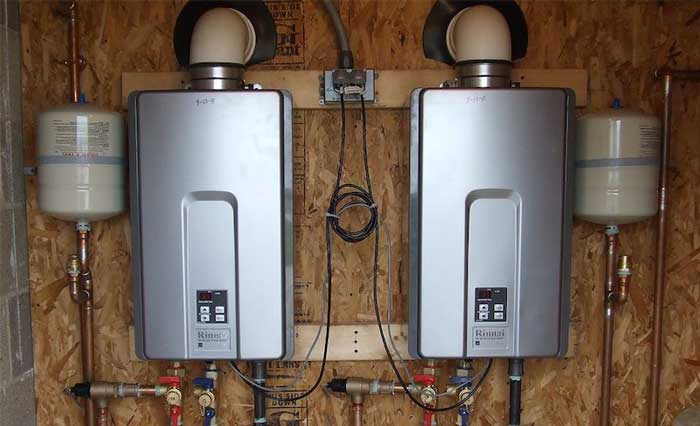
BTU output determines how quickly a tankless unit raises incoming cold water to the setpoint temperature at a given flow rate. The relationship depends heavily on incoming water temperature — a unit rated at 60,000 BTU will deliver its advertised flow rate at a 70°F temperature rise, but colder inlet conditions common in northern states and at elevation in early spring reduce the achievable GPM at the same BTU output. Buyers in cold-climate camping destinations should factor a 20–25% real-world reduction in rated flow capacity, which is why the FOGATTI InstaShower Ultra's 66,000 BTU rating carries a meaningful practical advantage over 42,000 BTU competitors when conditions get demanding.
Flow rate figures of 2.4–3.9 GPM span the practical range for RV applications. A typical RV showerhead flows at 1.5–2.0 GPM, meaning a 2.4 GPM unit like the Furrion covers a shower plus minor concurrent demand. At 3.9 GPM, the FOGATTI Ultra handles simultaneous shower and kitchen sink use without forcing either fixture to compromise on pressure. Buyers should also verify the minimum activation flow rate of any tankless unit under consideration — some units require 0.8–1.0 GPM to trigger ignition, which creates problems with low-flow showerheads and can cause cut-outs mid-shower when pressure fluctuates.
Installation Compatibility and Door Dimensions
RV water heater installations are constrained by the exterior compartment cutout dimensions established when the rig was manufactured. The most common opening for six-gallon tank heaters accepts a 12"x12" or 15"x15" door, while 10-gallon units typically use an 18"x18" opening. Tankless units that don't match these standard dimensions require custom cutting — a significant undertaking most owners prefer to avoid. The retrofit-focused products on this list were specifically engineered to eliminate this obstacle: the FOGATTI InstaShower 8 Plus offers three door sizes, and the Furrion targets the 10-gallon opening with its precisely dimensioned 18.11"x18.11" door.
Buyers replacing an existing Suburban unit with a new Suburban tankless model have the most straightforward path — matching brand installations typically share mounting patterns and connection locations. Cross-brand retrofits require careful measurement of both the opening dimensions and the available depth behind the exterior panel, as tankless units have different depth profiles than the tank heaters they replace. Consulting the owner's manual dimensional specifications before purchasing is the correct first step without exception.
Safety Features Worth Prioritizing in 2026
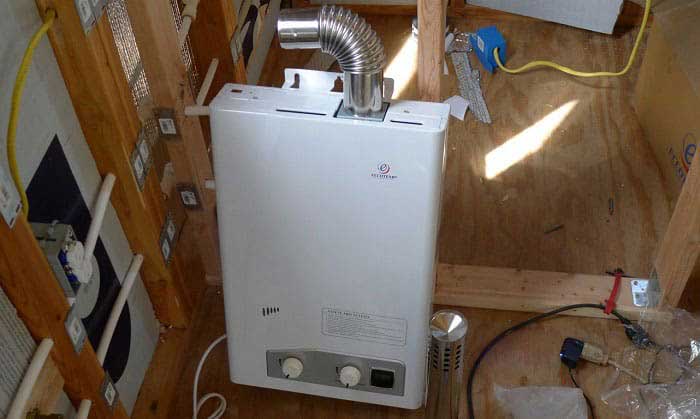
The safety feature landscape for RV water heaters has improved substantially in the most recent product generation. Flame-out protection — cutting gas supply when propane pressure drops below a safe operating threshold — is now present on most quality tankless units, but implementation quality varies considerably between brands. The Suburban ST-60's system is among the most aggressive and responsive in the category, monitoring continuously rather than only at ignition. High-temperature kill switches that cap outgoing water temperature are present on the Suburban ST-60 and Furrion units reviewed here, protecting against thermostat failures that could otherwise produce scalding conditions at the showerhead. Freeze protection is increasingly important for buyers who camp in four-season conditions, with automatic activation systems on the GIRARD and FOGATTI units providing genuine protection rather than requiring manual intervention at the worst possible moment. Families camping with young children should prioritize child lock functionality, which the Suburban ST-60 implements as a dedicated mode capping output at a safe 113°F.


Questions Answered
What is the best RV water heater for a family of four in 2026?
For families of four, the FOGATTI InstaShower Ultra Gen 3 is the strongest choice in 2026, delivering 66,000 BTU and 3.9 GPM of simultaneous capacity that handles back-to-back showers and concurrent kitchen use without forcing any user to wait. Families who prefer the simplicity of a tank system should opt for the Suburban SW10DE, whose 10-gallon volume provides adequate buffer for two consecutive showers before recovery is needed.
Is a tankless RV water heater worth the extra cost over a tank model?
The premium for a quality tankless unit is justified for buyers who camp frequently, use hot water for simultaneous multi-point demands, or want to reduce propane consumption across a full camping season. Tankless systems consume propane only when hot water is actively flowing, unlike tank heaters that cycle the burner continuously to maintain stored water temperature. For occasional campers who use hot water predictably and in modest volumes, the simpler tank design represents better value and lower long-term maintenance complexity.
How does altitude affect RV water heater performance?
Altitude reduces atmospheric oxygen concentration, which affects LP gas combustion efficiency and can cause incomplete burning, reduced BTU output, and ignition problems in water heaters not designed for high-elevation use. Units like the FOGATTI InstaShower 8 Plus and InstaShower Ultra, along with the GIRARD, include dedicated high-altitude modes rated to 9,800 feet. Buyers who regularly camp above 6,000 feet — common in Colorado, Utah, and the Sierra Nevada — should treat high-altitude compatibility as a non-negotiable specification rather than an optional feature.
Can an RV tankless water heater replace an old Atwood or Suburban tank unit directly?
Direct retrofit compatibility depends on the exterior door dimensions of the existing unit. Six-gallon Suburban and Atwood tank heaters use a standard 12"x12" opening that the FOGATTI InstaShower 8 Plus 15"x15" door option and the GIRARD unit accommodate, while 10-gallon units use an 18"x18" opening that the Furrion and FOGATTI 18"x18" door options cover. Buyers should measure both the exterior cutout dimensions and the available interior depth before purchasing any tankless replacement unit, as depth profiles differ meaningfully from the tank heaters they replace.
How much propane does an RV tankless water heater use compared to a tank unit?
GIRARD claims its 42,000 BTU tankless unit uses half the propane of a comparable six-gallon tank heater for an equivalent volume of hot water — a figure consistent with the on-demand heating model, where no propane is consumed maintaining stored temperature between uses. In practice, the propane savings depend heavily on usage patterns: full-timers who draw hot water throughout the day see the greatest efficiency gains, while weekend campers who use short hot water bursts may see less dramatic savings. Across a typical camping season, most users report meaningfully reduced propane consumption after switching from tank to tankless operation.
What annual maintenance does an RV water heater require?
Tank water heaters require annual anode rod inspection and replacement — typically every one to two years depending on water chemistry — along with tank flushing to remove sediment accumulation. The Suburban SW6DE and SW10DE simplify this with the combined anode rod and drain valve design. Tankless units require periodic cleaning of the burner assembly and heat exchanger to remove mineral scale, particularly in hard water regions, plus annual inspection of the igniter and flame sensor components. Both types benefit from winterization procedures — draining or blowing out water lines — when the RV will be stored in freezing conditions for any extended period.
Buy on Walmart
- Suburban Advantage RV Tank Water Heater SW6DE - 6 gallon Por — Walmart Link
- GIRARD Tankless RV Water Heater, 12V Power, 42,000 BTUs, Qui — Walmart Link
- Suburban Advantage RV Tank Water Heater SW10DE - 10 gallon P — Walmart Link
- FOGATTI InstaShower 8 Plus RV Tankless Water Heater, 3 Door — Walmart Link
- Suburban RV Tankless 60,000 BTU Water Heater - Endless Hot W — Walmart Link
- Furrion® RV Tankless Gas 60,000 BTU Water Heater - 18.11" x — Walmart Link
- FOGATTI InstaShower Ultra RV Tankless Water Heater, 66,000 B — Walmart Link
Buy on eBay
- Suburban Advantage RV Tank Water Heater SW6DE - 6 gallon Por — eBay Link
- GIRARD Tankless RV Water Heater, 12V Power, 42,000 BTUs, Qui — eBay Link
- Suburban Advantage RV Tank Water Heater SW10DE - 10 gallon P — eBay Link
- FOGATTI InstaShower 8 Plus RV Tankless Water Heater, 3 Door — eBay Link
- Suburban RV Tankless 60,000 BTU Water Heater - Endless Hot W — eBay Link
- Furrion® RV Tankless Gas 60,000 BTU Water Heater - 18.11" x — eBay Link
- FOGATTI InstaShower Ultra RV Tankless Water Heater, 66,000 B — eBay Link
Next Steps
- Measure the exterior compartment cutout dimensions on the RV before selecting any unit — door size compatibility is the first constraint to resolve and the most common source of return headaches.
- Check the current price of the FOGATTI InstaShower Ultra on Amazon to confirm it fits the budget; if not, the GIRARD and FOGATTI 8 Plus represent the next strongest options at lower price points.
- Cross-reference the selected unit's minimum activation flow rate against the RV's existing showerhead GPM rating to confirm reliable ignition compatibility before buying.
- Review the best RV generator guide if the chosen water heater includes an electric element or 12V control system that will draw from the battery bank at camp.
- Schedule annual maintenance — anode rod replacement for tank units, heat exchanger cleaning for tankless — at the start of each camping season to protect the long-term investment.


About Jake Mercer
Jake Mercer spent twelve years behind the wheel as a long-haul trucker, covering routes across the continental United States and logging well over a million miles. That career gave him an unusually thorough education in CB radio equipment — he has tested base station antennas, magnetic mounts, coax cables, and handheld units in real-world conditions where reliable communication actually matters. After leaving trucking, Jake transitioned to full-time RV travel and has since put hundreds of RV accessories through their paces across national parks, boondocking sites, and full-hookup campgrounds from Montana to Florida. At PalmGear, he covers RV gear and accessories, CB radios, shortwave receivers, and handheld radio equipment.
You can get FREE Gifts. Or latest Free phones here.
Disable Ad block to reveal all the info. Once done, hit a button below